
11 plus Non-Verbal Reasoning practice
Non-verbal reasoning is the one 11 plus subject that runs entirely on shapes and patterns rather than words. This is what it tests, the eight question types your child will meet, and how to answer them.
What the 11 plus tests in non-verbal reasoning
Non-verbal reasoning is the part of the 11 plus that works entirely in shapes and patterns rather than words or numbers. Every question shows a set of figures and asks the child to work out the rule connecting them, then apply it to pick the right answer from five options. There is no reading comprehension to get through first and no vocabulary threshold to clear, so a child who finds verbal reasoning or English hard going can still do well here.
That is also what makes it one of the more learnable parts of the eleven plus, rather than a mysterious one. Non-verbal reasoning only ever changes a small, fixed set of features: shape, size, number of sides, rotation, reflection, shading, line style, position, count, and inside versus outside. Once a child has that checklist in their head and runs through it on every question, “getting the hang of” non-verbal reasoning stops being a talent some children have and others do not. It becomes a habit of looking properly.
The non-verbal reasoning question types
Non-verbal reasoning covers eight question types. Each one tests the same underlying skill, spotting a rule in a set of shapes, but asks for it in a different way. Each has its own trap, and knowing the trap is most of the work.
Series
A row of five figures with one missing, and five options. Something changes from each figure to the next, a turn, a count, a shading, and often two at once. An arrow may turn a quarter clockwise in every box while the corner circles go up by one, so the missing figure has to get both right.
The trap is spotting one rule and stopping. Wrong options match one change and miss the other.
Odd One Out
Five figures sit in a row. Four share a rule and one breaks it. The rule might be a count, a symmetry, a shading, or how one shape relates to another. Here is a real one from 11+ Daily, drawn as your child meets it.
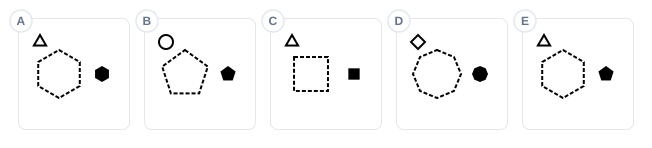
In four of them the big dashed shape and the small black one have the same number of sides. In E they do not: six against five. The small white shape at the top left changes in every figure and follows no rule at all, which is exactly what it is there for.
The trap is picking the figure that looks most different at a glance, such as the only round one. Ask what four of them share first.
Complete the Pair
Figures A and B form a pair, and a third figure, C, needs a partner. Whatever changed from A to B must happen to C: a rotation, a reflection, a swap of shading, a change of size, an element added or removed. If A is a white pentagon with a dot on its left and B is that same pentagon reflected and shaded black, then a white arrow with a dot on its left becomes a black arrow, reflected. It is the classic “A is to B as C is to what” format, done in shapes.
The trap is rotation against reflection. On a symmetrical shape the two look identical, and the options usually offer both, so use an asymmetric detail, a dot or an arrowhead, to tell them apart.
Complete the Grid
A grid of figures, usually three by three, has one square left empty. Rules run across the rows and down the columns at the same time. Every row might hold a circle, a square and a triangle in some order while every column shares a shading, so the empty square is whichever shape its row is missing, in its column’s shading.
The trap is reading only the row. An option that finishes the row but breaks the column is the classic distractor.
Find Like First Two
Two figures on the left share a property that is never named outright, and the child picks the option that shares it. With only two examples the evidence is thin, so precision matters: the rule might be “exactly one part shaded” or “one line of symmetry”. Two figures with exactly one shaded part each, set against options with two shaded parts or none, is a typical setup.
The trap is coincidence. Both examples might happen to be large without size being the rule. If a candidate rule fits three of the five options, it is not the rule.
Find Like First Three
The same task with three examples, which pin the rule down more firmly, so the wrong options are built tighter: each usually matches on every feature but one. Three figures might each show a shaded shape and an unshaded one, with the shaded one always the smaller, and one option has the shaded shape larger.
The trap is the near copy, an option that closely resembles one of the examples but breaks the rule in one small way. Test options against the rule, not against how the examples look.
Horizontal Code
Each figure in a key sits in a box with a code letter in the top corner and another in the bottom. Every letter stands for one property and always means the same thing. The child works out the meanings, then codes a figure whose corners are empty. If the top letter is for shape and the bottom for shading, with a circle as G, a square as H, empty as S and solid black as U, then an empty circle takes G on top and S below.
The trap is assuming the first letter is always the shape. It is whatever the key says. Compare two figures that share a letter, because what they share is what the letter means.
Vertical Code
The same idea, with each figure’s code written as a short string of letters beside it rather than in the corners, so the empty circle above becomes GS and a solid black square becomes HU.
The trap is position. Each letter carries one property, and children swap the order under pressure. Say it out loud: first letter shape, second letter shading.
How to answer a non-verbal reasoning question
- Work out what the question is actually asking before looking at the answer options: find the next figure, find the missing one, find the odd one, or find the match.
- Compare the figures given, not the answer options, first. Go through a fixed checklist: shape, number of sides, size, rotation, reflection, shading and fill, line style, position, how many of something there is, and what is inside compared with what is outside.
- Put the rule into a full sentence in your head, not just a feeling. “It turns a quarter clockwise each time” can be tested; “it looks different” cannot.
- Check the rule against every figure given, not just the first two. A rule that only explains one step is not the rule yet.
- Test the answer you have chosen against the rule one more time, checking every feature, before moving on.
Common mistakes
The traps above are specific to each type. Three habits cut across all eight.
- Working backwards from the options, picking whichever one looks about right, instead of naming the rule first and then finding the option that matches it.
- Checking one feature and stopping. Wrong options are built to catch a child who only looks at shape when the rule is about shading.
- Answering before the rule is a full sentence. “It turns a quarter clockwise each time” can be tested against every figure; “it looks different” cannot.
Where 11+ Daily fits
In 11+ Daily, every non-verbal reasoning figure is drawn as a vector shape rather than a photograph or a scan, so it stays sharp and clear at any screen size, from a phone to a laptop. Questions are worked on screen, which suits short daily sessions, but it is not a substitute for sitting a printed paper under timed conditions closer to how the actual 11 plus is sat.
Not every area sets a non-verbal reasoning paper, so it is worth checking what your own area’s 11 plus actually includes before building much practice time around this subject. There is more on what 11+ Daily costs and how the free trial works, and on what is and is not covered.
Questions parents ask
What is non-verbal reasoning in the 11 plus?
Does every 11 plus test include non-verbal reasoning?
How many non-verbal reasoning question types are there?
Can a child get better at non-verbal reasoning?
Practise Non-Verbal Reasoning in 11+ Daily
Non-Verbal Reasoning is one of the four subjects in 11+ Daily. The Today screen picks one skill a day, and parents see which ones are secure and which are not. 14-day free trial, no card needed.