11 plus Find Like First Three questions
Three figures share something that nobody tells you. Work out what it is, then find the one option out of five that shares it too.
What a Find Like First Three question looks like
Find Like First Three is a non-verbal reasoning question type in the 11 plus. Three drawn figures sit together on the left. They share one property, which the question never names, and the child picks the one option out of five that shares it too. There is nothing to read: the same short instruction sits above every question, so the whole question is in the drawing.
Its near neighbour, Find Like First Two, sets the same task with two example figures rather than three. The third example is the difference that matters, because a property two figures happen to share by accident rarely survives a third, so the rule is pinned down harder and the wrong options have to be built tighter: most match the examples on every feature but one.
The first example below is a real question, drawn as your child meets it. The other two are set out in words, in the order a child would look at it.
Two shapes on a diagonal
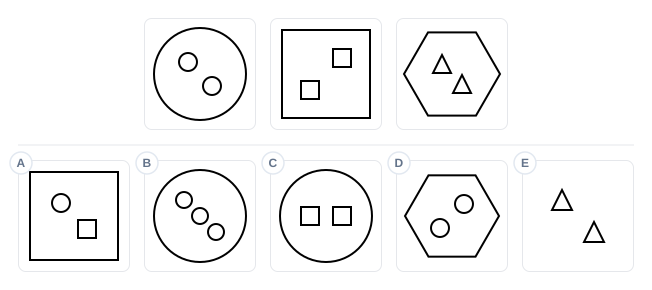
The kind of shape changes every time, so shape is not the rule. What holds across all three is the arrangement: one large outlined shape, holding exactly two smaller shapes that match each other, set on a diagonal inside it. The answer is D.
Each wrong option breaks one clause of that sentence, which is how this type is built once three examples have pinned the rule down. A holds two shapes on the diagonal but they do not match each other. B has the diagonal and the matching, but three shapes rather than two. C has two matching shapes side by side rather than on a diagonal. E has the pair and the diagonal and no large shape to hold them, so there is no inside for them to be in.
A dot on every corner
The first figure is a four-cornered shape standing on its point, with a small black dot on each of its four corners and a smaller white shape of the same kind sitting in the middle. The second is a five-sided shape with a black dot on each of its five corners and a smaller five-sided shape in the middle. The third is a six-sided shape, six dots, a smaller six-sided shape in the middle.
So the rule has two halves that have to hold together: a black dot on every corner, and a smaller white copy of the same shape at the centre. The answer is the option with a six-sided shape, a dot on each of its six corners, and a smaller six-sided shape in the middle of it.
The wrong options each drop one half. One has the dots right but the inner shape filled solid black, one has the dots right and nothing inside at all, and one has a circle in the middle instead of a matching shape. The dangerous one is a five-sided shape with a smaller five-sided shape inside, correct in every respect except that only four of its five corners carry a dot. At a glance it is exactly the picture a child is expecting, and only counting the dots against the corners catches it.
A line that crosses a side
The first figure is a triangle with a short straight line lying across its left-hand side, so part of the line is inside the triangle and part sticks out. The second is a square with a short line crossing its top edge, again part in and part out. The third is a five-sided shape with a short line crossing its lower right side.
Here the rule is not a property of one thing but a relationship between two: a shape with straight sides, and one short line crossing one of those sides so that some of the line is inside and some outside. The answer is the option showing a triangle with a short line lying across its right-hand side, part in and part out.
The tempting wrong option is a circle with a short line crossing its edge. Everything about the line is right, but a circle has no sides to cross. Another puts the line clear above a square so it touches nothing, and another gives the square two lines, one crossing an edge and one floating below the shape.
How to answer it
- Look at all three example figures before looking at the options. The options are drawn to be persuasive and will pull the rule out of shape.
- Describe the first figure completely, under your breath: what shapes, how many, how big, which fills, which way round, what is inside and what is outside, what touches or crosses what.
- Cross off everything in that description that is not also true of the second and third figures. What survives is the rule. Say it as a full sentence.
- Read the sentence back against all three examples once more. If it does not fit one of them, it is not the rule yet.
- Take the sentence to each option in turn and check every part of it. Four options should each break it in one place. If two survive, there is a feature you have not used.
Common mistakes
- Building the rule from the first figure alone. It usually fits the second, sometimes fits the third by luck, and then fits three of the options.
- Reading the shapes and ignoring the fill. White, solid black and striped count as three different things, and an option with the right arrangement and the wrong fill sits in most answer sets.
- Not counting. When the rule is a dot on every corner, an option that is one dot short looks right until the dots are counted against the corners.
- Accepting “nearly”. A shape that pokes out of the one meant to contain it, or a black shape that has drifted off centre, breaks the rule as surely as a missing shape does.
- Choosing the option that looks most like one of the examples. Resemblance is not the test, and the right answer often uses a shape none of the examples used.
How to practise 11 plus Find Like First Three questions
This type rewards a habit rather than knowledge, so a few questions a day beats a long session at the weekend. The habit is naming the rule in a full sentence before looking at the options, and it transfers to the rest of non-verbal reasoning. There is more on how much 11 plus practice a child needs each day, and on the other non-verbal reasoning question types a child will meet.
11+ Daily has a Find Like First Three project among its eleven plus practice, with rules drawn from counting, fill, nesting, position and symmetry. The questions are original to 11+ Daily: none is a past paper, none is licensed from another publisher, and the bank is re-checked in rounds, with anything that does not hold up rewritten or removed.
Questions parents ask
What is a Find Like First Three question in the 11 plus?
What is the difference between Find Like First Three and Find Like First Two?
What sort of rules appear in Find Like First Three questions?
How can a child get better at Find Like First Three questions?
Practise Find Like First Three in 11+ Daily
Find Like First Three is one of the 78 skill projects in 11+ Daily. The Today screen brings it round when it is the right thing to revise, and a wrong answer comes back in a later session until it is right. 14-day free trial, no card needed.

