11 plus Odd One Out questions
Five drawn figures sit in a row. Four of them share something, one does not, and the whole question is in the picture. The hard part is naming what the four share before deciding which one is out.
What an Odd One Out question looks like
Odd One Out is a non-verbal reasoning question type in the 11 plus. Five drawn figures sit in a row, four of them follow the same rule, and your child taps the one that breaks it. It shares half its name with the verbal reasoning format Two Odd Ones Out, and the difference is worth settling first: this one works on drawn figures and asks for one answer, where that one works on written words and asks for two.
The rule is never written down, so the whole question is in the drawing. It may turn on a count, a fill, a symmetry, a direction, which shape sits in front, or a design turned round rather than flipped over. The first example below is a real question, drawn; the other two are set out in words, in the order a child would look at them.
A rule about which shape sits in front
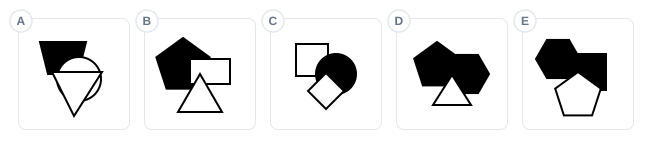
Nothing here counts and nothing turns, so run down the overlaps instead and ask, each time two shapes cross, which one is on top. In A, B, D and E the white shape is always the one in front, whatever it happens to be. C breaks it: its white rectangle is behind the black circle. C is the odd one out.
C is built to be missed, because it also has a white shape in front, the small four-sided one lying over the circle. A child who finds one white shape on top and stops is satisfied by all five. The rule has to hold at every overlap in a figure, not just at the first one you look at.
A rule about which way something points
Each figure has two shapes with an arrow between them, one small and solid black, the other larger and outlined.
The first: a black six-sided shape on the right, an outlined square on the left, arrow pointing left. The second: a black square on the far left, an outlined five-sided shape on the right, arrow pointing right. The third: a black circle at the top, an outlined square below, arrow pointing down. The fourth: a black triangle at the top left, an outlined circle at the bottom right, arrow pointing up and left. The fifth: a black five-sided shape at the bottom left, an outlined triangle at the top right, arrow pointing up and right.
No two figures use the same pair of shapes or sit at the same angle, so hunting for the one that looks different gets nowhere. Say what the arrow does instead: it runs from the small black shape to the larger outlined one. The fourth is the odd one out, its arrow running the other way, from the outlined circle back to the black triangle.
The third tempts a child who notices that its arrow is the only one pointing straight down. Direction on the page is not the rule. Which shape it starts from is.
A rule about turning, with one figure flipped
Every figure is one solid black shape: a long bar with a shorter block standing at one end, so it reads like a capital L.
The first has the bar along the bottom, block standing up at its right-hand end. The second has the bar along the top, block hanging down at its left-hand end. The third stands the bar upright on the left, foot out to the right at the bottom. The fourth stands it upright on the right, foot out to the left at the bottom. The fifth stands it upright on the right, foot out to the left at the top.
Start at the loose end of the bar, run your finger along to the corner, then carry on into the block. In the first, second, third and fifth it goes off the same way, so those four are one shape at four angles. In the fourth it goes off the other way: it has been flipped over, like a hand held up to a mirror, and turning will never match it. The fourth is the odd one out.
The fifth costs the marks: it stands upright on the right with a foot to the left, exactly like the fourth, and only the height of the foot separates them.
How to answer it
- Look at all five figures before choosing. The rule belongs to the group, so a decision made on the first figure you notice is a guess.
- Ask what four of them share, not which one looks different. The large shapes are usually all different on purpose, so “it looks different” fits every figure.
- Run a fixed checklist: how many of each small thing, what shape, filled in or left white, which way it points, what is inside and outside, which shape sits in front, solid outline or dashed.
- Say the rule as a full sentence. “Every figure has five small marks around it” can be tested. “Something is different about that one” cannot.
- Check it against every figure and make sure exactly one breaks it. Two means the rule is too loose. None means it is the wrong rule.
Common mistakes
- Picking the figure that looks most different at a glance. The large shapes are usually all different by design, so that instinct aims at the noise, not the rule.
- Counting one kind of thing when the rule counts everything. A figure with three black diamonds among figures with two is doing its job as a wrong option.
- Treating a flipped figure as a turned one. Four figures at four angles with one mirror image among them is a common build here.
- Reading the shapes and ignoring how they are drawn. Solid black, plain white and striped are three different fills, and lines slanting up to the right are not lines slanting down.
How to practise 11 plus Odd One Out questions
This question type rewards one habit above all: naming what the four have in common as a full sentence, out loud, before deciding which figure is out. When one goes wrong at home, ask what rule the other four follow rather than handing over the answer, because the mistake is nearly always in the rule and not in the looking. A few figures a day beats a long weekend session here, as across eleven plus preparation generally: see how much 11 plus practice a child needs each day.
11+ Daily has an Odd One Out project alongside the other non-verbal reasoning question types, and every figure is drawn as a vector shape, so it stays sharp on a laptop, tablet or phone. The questions are original to 11+ Daily: none is a past paper, none is licensed from another publisher, and the bank is re-checked in rounds.
Questions parents ask
What is an Odd One Out question in the 11 plus?
How is Odd One Out different from Two Odd Ones Out?
Why does the odd figure sometimes look like all the others?
What is the difference between a turned figure and a flipped one?
How can a child get better at Odd One Out questions?
Practise Odd One Out in 11+ Daily
Odd One Out is one of the 78 skill projects in 11+ Daily. The Today screen brings it round when it is the right thing to revise, and a wrong answer comes back in a later session until it is right. 14-day free trial, no card needed.

