11 plus Find Like First Two questions
Find Like First Two is a non-verbal reasoning question type. Two figures have one thing in common that is never written down, and your child has to work out what it is and find the option that shares it.
What a Find Like First Two question looks like
Find Like First Two is one of the non-verbal reasoning question types in the 11 plus. Two figures sit on the left with one thing in common, and that thing is never written down anywhere. Five options follow, and exactly one of them shares it. There is no reading to do: the same short instruction sits above every question, so the whole question is in the drawing.
What sets it apart from the other similarities question type is how much evidence a child gets: this one gives two example figures where its neighbour gives three, so a feature the two happen to share by chance can look exactly like the real rule.
The first example below is a real question, drawn as your child meets it. The other two are set out in words, in the order a child would look at them.
A triangle with three small shapes
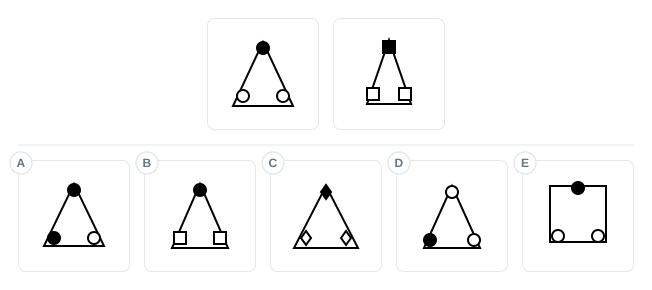
The small shapes have changed between the two examples, and that is the clue: what changes cannot be the rule. What has not changed is everything else. A triangle, three small shapes that match each other, one black at the top, two white at the bottom.
The answer is C, three small diamonds, black above the top point and white near the bottom corners. The diamond appears in neither example, which is fine: the kind of shape was never the point.
Two wrong options are worth naming. A has circles in exactly the right places but makes the bottom-left one black as well, so two are black instead of one. D moves the black shape to a bottom corner and leaves a white one at the top. B is the quieter trap: everything is in the right place and the right colour, but a circle at the top and squares at the bottom means the three no longer match each other.
A big shape and a column of small ones
The first figure is a large white pentagon on the left, with four small solid black squares stacked one above another in a straight column down the right-hand side. The second figure is a large white triangle on the left, with four small solid black circles in the same column on the right.
Again the shapes are free and everything else is fixed: one big shape, white; four small ones, black, matching each other, in a column to its right. The answer is a large white hexagon with four small black diamonds in a column on the right.
Each wrong option breaks one part of that sentence. One has the column of four black circles right but fills the big shape solid black. One puts the four small shapes in a row along the bottom instead of a column at the side. One has only three of them. One alternates circles and squares, so they stop matching each other.
Four shapes inside a frame
The first figure is a large square frame holding four shapes in two rows: two squares along the top, two triangles along the bottom. Each one is half white and half black, and the black halves face inwards, so the left-hand pair is shaded on its right and the right-hand pair on its left. The right half of the frame mirrors the left.
The second figure is the same frame with circles along the top and pentagons along the bottom, shaded and mirrored the same way. The answer keeps the frame and uses hexagons along the top and squares along the bottom.
One wrong option shades the right-hand pair the same way round as the left-hand pair instead of mirroring it, which is the difference between a copy and a mirror image. One uses squares in both rows, so the rows stop being different.
How to answer it
- Look at the two figures on the left and nothing else to start with. The options are designed to pull you off the rule before you have found it.
- Run a fixed checklist over both figures: the big shape, how many small shapes there are, whether they match each other, what is black and what is white, what is inside and what is outside, and whether one side mirrors the other.
- Note what is different between the two examples. Anything that changes from the first figure to the second cannot be the rule, and that is the most useful thing two examples give you.
- Say the rule as a full sentence. “A triangle with three matching small shapes, the top one black and the bottom two white” can be tested against five options. “They are the same sort of thing” cannot.
- Take the sentence to the options one at a time and check every part of it. If two options survive, there is a feature you have not used yet.
Common mistakes
- Treating a coincidence as the rule. With only two figures to go on, several things are shared by accident. If a candidate rule fits three of the five options, it is not the rule.
- Ruling an option out because its shapes are new. The answer very often uses a shape that appears in neither example. Test options against the rule, not against how the examples look.
- Picking the near copy. Most answer sets contain an option that closely resembles one of the two examples but breaks the rule in one small way. It looks safe because it looks familiar.
- Checking one feature and stopping. Wrong options are built to catch a child who checked the shapes and never looked at which one was black.
- Missing the small stuff. Which one is shaded, which side of it is shaded, whether four things sit in a column or a row: these carry the rule far more often than the outline does.
How to practise 11 plus Find Like First Two questions
The useful practice here is the sentence, not the volume. Ask your child to say what the two figures have in common before they look at the answers, and keep asking until the sentence covers every feature rather than the first one they noticed. When they get one wrong, do not hand over the answer: ask what their option got right and which single part of the sentence it broke, because that is the lesson here. Short sessions suit it, and there is more on how much 11 plus practice a child needs each day. 11+ Daily has a Find Like First Two project among the non-verbal reasoning skills it covers. Not every eleven plus area sets a non-verbal reasoning paper, so check what your own area’s test includes before building much practice time around it.
Questions parents ask
What is a Find Like First Two question in the 11 plus?
Why is having only two example figures harder than it sounds?
Does the right answer look like the two example figures?
How can a child get better at Find Like First Two questions?
Practise Find Like First Two in 11+ Daily
Find Like First Two is one of the 78 skill projects in 11+ Daily. The Today screen brings it round when it is the right thing to revise, and a wrong answer comes back in a later session until it is right. 14-day free trial, no card needed.

