11 plus Series questions
Five boxes in a row, one of them empty, and the rule that links the drawings is never written down. The empty box is not always the last one, which is where most children come unstuck.
What a Series question looks like
Series is a non-verbal reasoning question type in the 11 plus. Five boxes sit in a row, one of them is empty, and your child picks the figure that belongs in it from five drawn options. It shares its name with the verbal reasoning types Number Series and Letter Series, and sits near the maths topic Sequences & Patterns, so the difference is worth settling first: those run along a line of numbers or letters and always ask for the next one, while this one runs along a line of drawings and asks for a missing one, which is often not the last.
That last point is where most children come unstuck. In our own bank the empty box is at the end in fewer than half the questions. The rest put it at the fourth box, in the middle, or right at the start, so a child who has only learned to carry a pattern on one more step will stall the first time the gap is box one. The method has to run backwards as well as forwards.
The rule is never written down, and there is usually more than one running at once: a shape can turn, change its fill and gain a mark in the same step. The second example below is a real question, drawn; the other two are set out in words, in the order a child would look at them.
A gap in the middle
Box one holds a triangle with a small solid black dot at its centre. Box two holds a square with a small white dot. Box three holds a five-sided shape with a black dot. Box four is empty. Box five holds a seven-sided shape with a black dot.
Count the sides first: three, four, five, gap, seven. The shape gains one side each step, so the missing figure has six sides. Now look at the dot: black, white, black, gap, black. It swaps every step, so the missing one is white.
The answer is a six-sided shape with a white dot in the middle. The wrong option most children reach for is a six-sided shape with a black dot: they solve the sides, see the shape they expected and stop. The other trap is a seven-sided shape with a white dot, which gets the dot right but uses the shape already sitting in box five.
A gap near the start
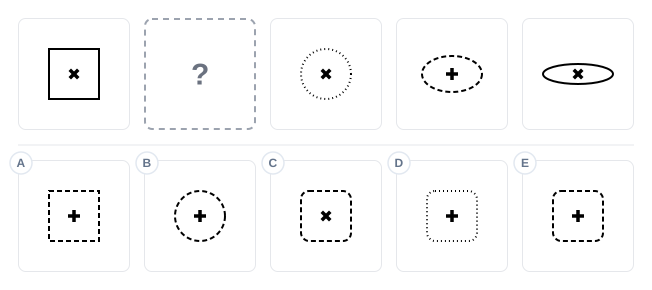
Three things change along the row, and because the gap is second each has to run backwards from box three as well as forwards from box one. The outline goes solid, gap, dotted, dashed, solid, so box two is dashed. The mark inside goes cross, gap, cross, plus, cross, so box two is a plus. The shape starts square, rounds into a circle, then flattens into an oval, so box two is a square whose corners have only just begun to round.
The answer is E. Each of the other four breaks exactly one of the three rules: A keeps its square corners, B has rounded all the way to a circle, C leaves the cross in place, D is dotted a step early. A child who solves two rules and stops lands on one of them.
Three rules at once
Box one holds a small black square on the left and a white circle on the right. Box two is empty. Box three has the same arrangement, with the black square a little bigger. Box four turns it round: a bigger white square on the right, a black circle on the left. Box five is bigger again, black square back on the left, white circle on the right.
Three things happen together. The square swaps sides every step. Whichever shape is on the left is the black one. And the square grows by the same amount every step, so the missing square is one size up from box one and one size down from box three.
The answer is a black circle on the left with a white square on the right, that square a little bigger than the one in box one. One wrong option gets the layout and the fills right but draws the square the size it already is in box three, which is what a child picks when they miss the growing. Another swaps the fills, giving a white circle and a black square.
How to answer it
- Find the empty box and say where it is. If it is box one or box three, you will be working backwards from a later box.
- Compare each box with the one next to it, never the first with the last. The rule lives in the step.
- Name everything that changes, out loud if it helps: the shape, how many sides it has, which way it faces, whether it turns a quarter turn each time, how it is filled in, how many small marks it carries and where they sit.
- Work out the missing figure in your head before looking at the options. Deciding first stops the options talking you into something.
- Check your choice against every rule you named, not just the first. If two options survive, you have missed a rule.
Common mistakes
- Assuming the empty box is the last one. It very often is not, and a child who only continues patterns forwards has no method for a gap at the start.
- Solving one rule and stopping. If the shape turns and its fill also swaps, there will be an option with the right shape and the wrong fill waiting.
- Picking a figure that already appears in the row. In sequences that swap back and forth the answer sometimes does repeat an earlier box, so check rather than rule it out.
- Missing a size change. Growing and shrinking are easy to miss next to a shape that is turning, and the wrong options are often the right figure at the wrong size.
- Treating a turned figure as a flipped one. A turned figure matches by turning the page; a flipped one is a mirror image and never will.
How to practise 11 plus Series questions
The habit worth building is saying the rules out loud before choosing, as a list: what changes from one box to the next, and what stays the same. When one goes wrong at home, ask which rule was missed rather than which option was right, because the mistake is almost always a rule left off the list. Little and often beats a long weekend session here, as across eleven plus preparation generally: see how much 11 plus practice a child needs each day.
11+ Daily has a Series project alongside the other non-verbal reasoning question types, with the gap falling in different places so a child gets used to reading a sequence in both directions. Every figure is drawn as a vector shape, so it stays sharp on a laptop, tablet or phone. The questions are original to 11+ Daily: none is a past paper, none is licensed from another publisher, and the bank is re-checked in rounds.
Questions parents ask
What is a Series question in the 11 plus?
Is the missing figure always at the end of the row?
How is Series different from Number Series and Letter Series?
Why do children lose marks on Series questions they say were easy?
Practise Series in 11+ Daily
Series is one of the 78 skill projects in 11+ Daily. The Today screen brings it round when it is the right thing to revise, and a wrong answer comes back in a later session until it is right. 14-day free trial, no card needed.

