11 plus Complete the Grid questions
A grid of shapes has one box left empty. Two rules run through it at once, one across the rows and one down the columns, and the answer has to satisfy both.
What a Complete the Grid question looks like
Complete the Grid is a non-verbal reasoning question type in the 11 plus. It shows a grid of drawn figures with one box left empty, and five options to fill it. Most grids are three boxes across and three down, and some are two by two. What makes the type its own thing is that two rules run through the grid at the same time, one across each row and one down each column, and the answer has to satisfy both: its nearest neighbour, Complete the Pair, only asks a child to spot one change and copy it onto a single figure.
There is nothing to read: no words and no numbers, and the same short instruction sits above every question, so the whole question is in the drawing. The third example here is a real question, drawn; the other two are set out in words, in the order a child would look at them.
A two by two grid
Four boxes, two across and two down. Top left holds a white arrow pointing up. Top right holds the same arrow, filled solid black. Bottom left holds a white arrow pointing down. The bottom right box is empty.
Read across first. The arrows in the top row point up, and the arrow in the bottom row points down, so the row decides which way the arrow points. Now read down. The arrows in the left column are white and the arrow in the right column is black, so the column decides the colour. The empty box is in the bottom row and the right column, so it needs an arrow pointing down, filled solid black.
The tempting wrong answer is a white arrow pointing down: it gets the row right and stops there. A black arrow pointing up does the same with the column.
A three by three grid
Nine boxes. Each holds a large five-sided shape with small white circles in a row inside it. Reading the top row from the left: a black shape with one circle, a white shape with two circles, a striped shape with three circles. The middle row: a white shape with two, a striped shape with three, then the empty box. The bottom row: a striped shape with three, a black shape with one, a white shape with two.
Every row uses each of the three shadings once and each of the three counts once, and so does every column. The gap is at the end of the middle row. That row already has a white shape and a striped one, so the missing one is black. It already has two circles and three, so the missing count is one. The column agrees: three circles at the top, two at the bottom, so one is what is left. The answer is a black five-sided shape with a single circle inside.
Two options are built for a child who half-finishes. One is a black shape with two circles: the right colour, with the count copied from the box next to it. The other is a striped shape with one circle: the right count, in a shading the row has already used.
A three by three grid where the picture turns
Not every grid is one of each.
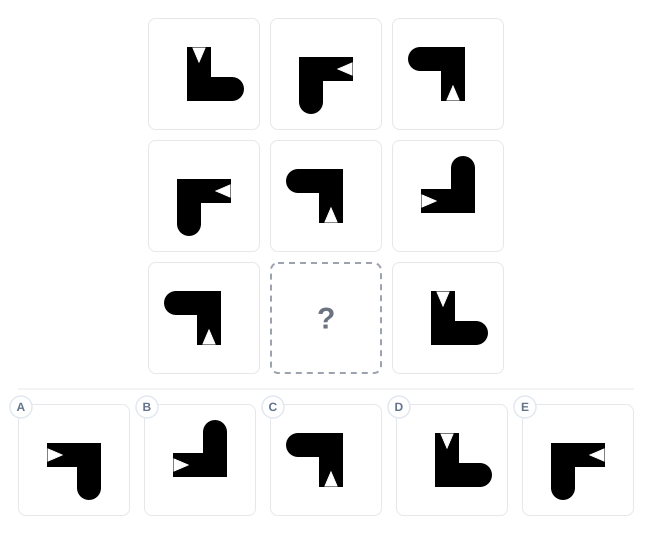
There is only one shape in this grid and only one thing happening to it. Every step to the right turns it a quarter turn clockwise, and so does every step down, which is why the diagonals repeat. Pick the notch and follow it round: it starts at the top, and a quarter turn clockwise sends it to the right. The gap is the middle of the bottom row, three quarter turns on from that row’s start, so the notch has to finish on the left. The answer is B.
A is the one that costs marks, and it is why you follow a lopsided detail rather than a general impression. It is turned by exactly the right amount but also flipped over, so the notch and the rounded tip sit the wrong way round from each other. C, D and E each turn it by the wrong amount, and each is a box already sitting in the grid.
How to answer it
- Look at the whole grid first. Count how many boxes go across and down, and find the empty one.
- Read across a complete row and put what changes into a full sentence. “It turns a quarter turn each time” can be tested against the next box. “It looks different” cannot.
- Read down a complete column and do the same. This is the step children skip, and it is where the marks are.
- Describe the missing box out loud before looking at the options: its shape, its shading, which way it faces, and how many of each thing it holds.
- Take that description to the five options and check every feature against it. If two survive, there is a feature you have not used yet.
Common mistakes
- Finishing the row and forgetting the column. Nearly every question offers a figure that completes the row perfectly and breaks the column, and it is the commonest wrong answer here.
- Copying a box that is already in the grid. Most answer sets contain a figure that appears somewhere on screen already. It looks familiar and safe, and it is usually a trap.
- Reading the shape but not the shading. Solid black, plain white and striped count as three separate things, and a striped option sits in most answer sets for the child who only looked at outlines.
- Assuming every grid is one of each. Some count, some add, and some turn a figure a quarter turn at each step, so a child who has learned only that one pattern will force it onto a grid that does not use it.
- Guessing the turn. Where a figure turns, the options usually offer the quarter turn, the half turn and the three-quarter turn together. Find one lopsided detail, a dot or a notch, and follow it round the grid.
How to practise 11 plus Complete the Grid questions
This question type rewards a habit rather than knowledge, so a few questions a day beats an hour at the weekend. The habit is small: read the column as well as the row, every time, and say what the missing box must be before looking at the options. There is more on how much 11 plus practice a child needs each day, and on the other seven non-verbal reasoning question types a child will meet.
11+ Daily has a Complete the Grid project among its eleven plus practice, with grids of both sizes and a mix of rules, and every figure is drawn so it stays sharp on a laptop, tablet or phone. The questions are original to 11+ Daily: none is a past paper, none is licensed from another publisher, and the bank is re-checked in rounds, with anything that does not hold up rewritten or removed.
Questions parents ask
What is a Complete the Grid question in the 11 plus?
What is the difference between Complete the Grid and Complete the Pair?
What rules appear in Complete the Grid questions?
How can a child get better at Complete the Grid questions?
Practise Complete the Grid in 11+ Daily
Complete the Grid is one of the 78 skill projects in 11+ Daily. The Today screen brings it round when it is the right thing to revise, and a wrong answer comes back in a later session until it is right. 14-day free trial, no card needed.

