11 plus Complete the Pair questions
Complete the Pair is a non-verbal reasoning question type. Two figures form a pair, and your child has to spot what changed between them and do exactly the same thing to a third figure.
What a Complete the Pair question looks like
Every Complete the Pair question in the 11 plus is a drawing rather than a piece of text. Two figures sit side by side and form a pair: the second is the first after something has been done to it. A third figure sits on its own, and five options follow. The job is to work out what happened between the first two, do the same to the third, and pick the option that results. It is the shape version of “A is to B as C is to what”. What marks it out from Complete the Grid, the other non-verbal reasoning type with a missing figure to find, is that here the change is shown once and applied once, rather than having to satisfy a rule across a row and a second rule down a column at once.
The first example below is a real question, drawn as your child meets it. The other two are described in full.
A turn and a change of shading
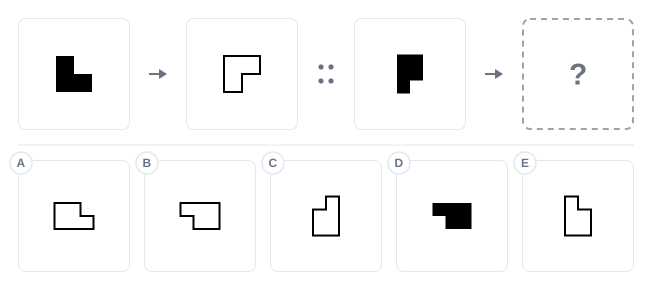
Two things happen between the first figure and the second. It turns a quarter turn clockwise, and the solid black becomes white with a thin outline. Do both to the third figure and the answer is B.
D is the one to watch: it gets the turn exactly right and leaves the shape solid black, which tempts a child who spotted the turn and felt finished. A turns the same amount the other way and E is flipped rather than turned, both aimed at the child who noticed the fill first and then guessed at the movement.
A piece added
The first figure is a four-sided shape, white with a black outline, narrower across the top than the bottom. The second is that same shape, unchanged in size, position and shading, with one addition: a small solid black dot sitting on its top-right corner. Nothing else is different. The rule is simply to add a small black dot at the top-right corner.
The third figure is a curved shape like a crescent moon, again white with a black outline. The answer is that crescent, otherwise untouched, with a small black dot at its top right.
The wrong options work on where the dot goes rather than whether there is one. One puts it at the top left. One flips the crescent over and carries the dot round with it. And one leaves the crescent exactly as it was, with no dot at all, which is more tempting than it sounds: a child who cannot see a difference between the first two figures concludes there is not one.
Two turns at once
The first figure is a five-sided shape, white with a black outline, holding a small solid black triangle that points to the right. The second is the whole thing turned a quarter turn anticlockwise. But the little triangle has not simply travelled round with it: it has also been turned upside down where it sits, so it ends up pointing down rather than up.
The third figure is another five-sided shape, holding a small solid black shape like a capital L. The answer turns the whole figure a quarter turn anticlockwise and turns that L upside down inside it.
The wrong option to watch is the one that turns the outer shape correctly and carries the inner shape round as a passenger, without the extra flip. Everything about it is right except the one thing the question is really testing, and that is the shape of most Complete the Pair distractors.
How to answer it
- Look at the first two figures only. Ignore the options to begin with, and the third figure too: everything you need is in the pair.
- Go through a fixed checklist and note every difference: which way round it is, whether it has been flipped, its size, its shading, how thick or dashed the outline is, how many pieces there are, and where each one sits.
- Say the change as a full sentence, and check the sentence covers everything you found. “It turns a quarter turn clockwise and the black fill becomes white with an outline” can be tested. “It looks different” cannot.
- Do that change to the third figure in your head before reading a single option.
- Check the option you chose against every part of your sentence, not just the part you noticed first.
Common mistakes
- Spotting one change and stopping. Many questions change two or three things at once, and the wrong options are built so that each one gets all but one of them right.
- Turning the figure the wrong way. A quarter turn clockwise and a quarter turn anticlockwise usually both appear among the options. Fix the direction against a lopsided detail, a bitten corner, an arrowhead, a dot, rather than against the overall outline.
- Confusing a turn with a flip. On a nearly symmetrical shape the two produce figures that look alike, and both are offered. Again, follow the one part that is not symmetrical.
- Working backwards from the options. Reading the answers first invites a child to pick whichever looks closest to the third figure, which is precisely the trap: several of the wrong ones are the third figure barely altered.
- Changing something meant to stay put. Some questions deliberately leave one part of the figure alone, and the answer leaves it alone too. A child hunting for changes will sometimes change it anyway.
How to practise 11 plus Complete the Pair questions
The useful practice here is not volume, it is the sentence. Ask your child what changed between the first two figures before they touch the answers, and keep asking until the sentence covers everything rather than the first thing they noticed. When they get one wrong, resist giving them the answer: ask what their option got right and what it missed, because that is the whole lesson here. Short sessions suit it better than long ones, and there is more on how much 11 plus practice a child needs each day. 11+ Daily has a Complete the Pair project among the non-verbal reasoning skills it covers, and every answer is followed by the change written out in words, which is the habit you want copied. Not every eleven plus area sets a non-verbal reasoning paper, so check what your own area’s test includes first. There is more on what is and is not covered.
Questions parents ask
What is a Complete the Pair question in the 11 plus?
How is Complete the Pair different from Complete the Grid?
What catches children out in Complete the Pair questions?
How can a child get better at Complete the Pair questions?
Practise Complete the Pair in 11+ Daily
Complete the Pair is one of the 78 skill projects in 11+ Daily. The Today screen brings it round when it is the right thing to revise, and a wrong answer comes back in a later session until it is right. 14-day free trial, no card needed.

