11+ Non-Verbal Reasoning explained: how to help your child
Non-Verbal Reasoning feels like a knack. It is closer to a checklist: find one change, cross out every answer that breaks it, then find the next. Watch a question solved that way, then how to help your child do the same.
A checklist, not a knack
Of all the 11 plus subjects, Non-Verbal Reasoning is the one parents most often say they cannot help with. But only a handful of things ever change in the figures: shape, count, shading, line style, turning, flipping, size, position, direction and symmetry. Children who seem to have a knack for it are checking that list, one change at a time, and crossing out answers as they go.
Here is a Complete the Pair question from 11+ Daily solved that way. Press play, or step through it with the arrows.
How to solve 11 plus Non-Verbal Reasoning questions
- Find one change in the figures the question gives you. Look at the options later.
- Say it in a sentence: “it turns a quarter clockwise”.
- Cross out every option that breaks it.
- Find the next change and repeat. Most questions change two or three things, and the wrong options are built to pass the first rule.
- Stop when one option is left, and check it against every rule once more.
The common slips are stopping at the first rule, picking the option that is almost a copy of an example, and miscounting dots or lines. Our guide to the GL Non-Verbal Reasoning question types goes through each eleven plus question family.
How to help your child with Non-Verbal Reasoning at home
You do not need to see the rule first to help. Your job is to ask the questions in the method out loud and let your child answer them.
- “What changes from this one to the next?” One thing at a time. If they name two at once, ask them to pick one.
- “Which answers break that?” Cross them out together, on paper or with a finger, so the shrinking list is visible.
- “What did your answer get right?” A wrong answer usually fits one rule and breaks another. Finding the rule it broke is the lesson.
What to say when your child is stuck
Resist giving the answer. Point back to the list and ask which things they have checked: “Have you looked at the shading yet? What about the number of lines?” A child who finds the second rule themselves remembers it; a child who is told forgets it by the next question.
If you are both stuck, read the worked explanation together, one line at a time, and ask your child to show you each change in the figures. Watching a question solved, like the one above, does the same job: each rule is pointed out in the figures and each wrong answer is crossed out with the reason.
Keep it short and calm. A few questions on most days builds the habit faster than a long session at the weekend, and speed comes once the method is reliable. There is more on how much 11 plus practice a child needs each day.
Non-Verbal Reasoning your child can watch solved
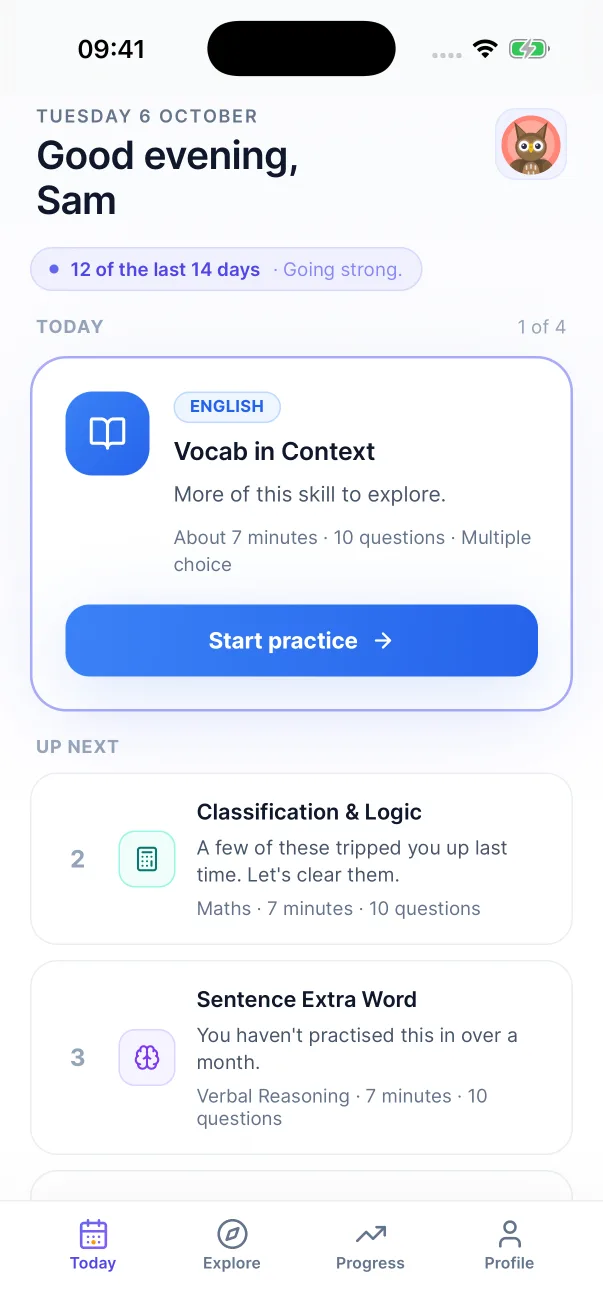
11+ Daily has all eight Non-Verbal Reasoning question types, and the Today screen picks which one your child practises next from what is weak. When a question goes wrong, your child can watch it solved like the one above, and it comes back in a later session until it is right. The parents area shows accuracy for each question type, so you can see what needs work without having to see the rule yourself. Start your free 14-day trial, every subject unlocked and no card needed.
Last updated 10 November 2026.
Try 11+ Daily with your child.
11+ Daily lets your child watch a Non-Verbal Reasoning question they got wrong solved on the question itself, one rule at a time, and brings it back until it is right.
14 days free, no card. Then £9.99 a month if you carry on.