11+ comprehension in 11+ Daily: reading a passage and answering on it
Comprehension is the heart of the 11 plus English paper. In 11+ Daily it is a passage of fiction, non-fiction or poetry to read, with questions on it, answered as a paper and marked when your child submits.
A passage, then questions on it
Nearly every 11 plus English paper has a comprehension at its heart: a passage your child has never seen, then questions on it. It is also the hardest part to practise at home. You need passages at the right level, questions that ask what a real paper asks, and someone who can explain why an inference answer is right, which is not easy when you are unsure yourself.
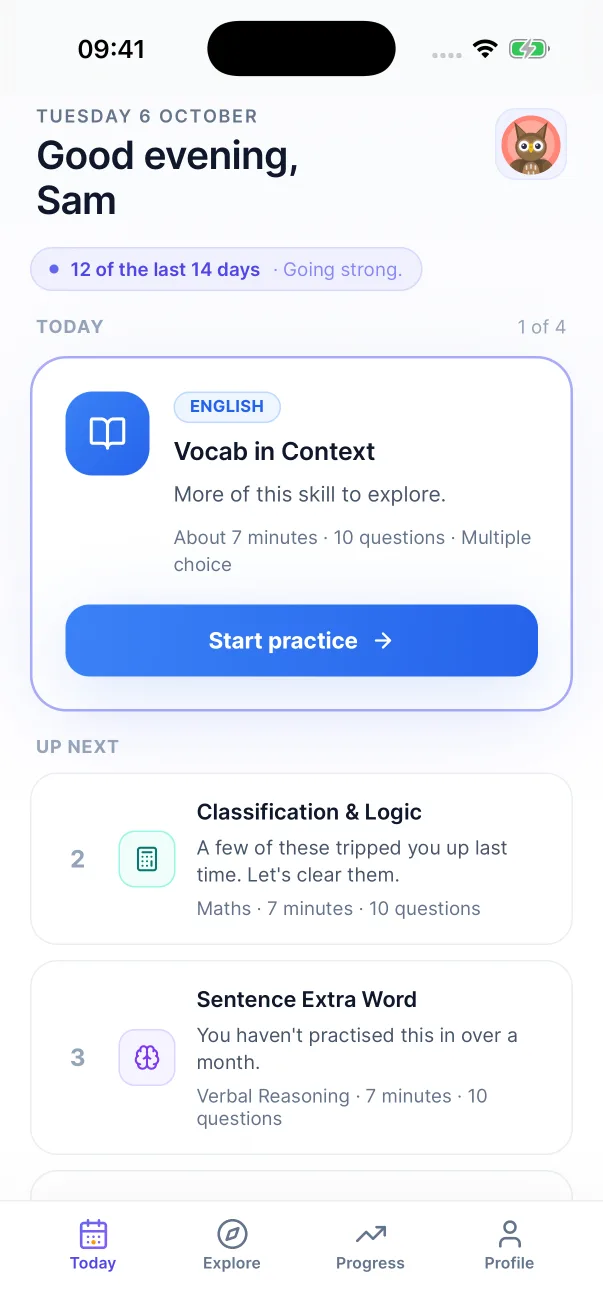
In 11+ Daily comprehension is one of the English skills, and it appears on the Today screen like any other session. There is nothing to set up. Your child reads the passage, answers the questions as a paper and submits, and every question is marked with an explanation that points back to the text. The result goes into the parents area with everything else. It is a longer session than most, usually ten to fifteen minutes, because reading the passage properly is the point.
Start your free 14-day trial to try it, with every subject unlocked and no card needed.
A comprehension practises the format: going back to the text, and reading the question for what it actually asks. The skill underneath comes from reading widely over years, which is why it works best alongside daily reading. For the routine around it, see how to practise 11 plus comprehension at home.
What the 11 plus comprehension questions ask
The passages are fiction, non-fiction and poetry. The non-fiction ranges across articles, newspaper reports, letters, journals, leaflets and explanations, because an eleven plus paper can use any of them, and a fiction or non-fiction passage runs to about 700 words, with a poem shorter. The fiction is original to 11+ Daily. Some of the non-fiction and poems are classic texts, Robert Louis Stevenson among them, because older language turns up on real papers too.
Every question has five options, and between them they ask what comprehension papers ask:
- Finding a fact. Questions whose answer is stated in the passage. The skill is going back for it rather than trusting memory.
- A word in its sentence. Questions on what a word means as it is used there, which is often not its everyday meaning.
- Reading between the lines. Inference questions, where the answer is not written down but has to be supported by something that is.
- What kind of word it is. Questions on word class: whether a word is a noun, a verb or an adjective in that sentence, which is a favourite trap when a familiar noun is used as a verb.
- The writer’s choices and the whole passage. The rest ask why a word or comparison was chosen, which figure of speech a line uses, what the passage is mainly about, or the order things happened in.
Three of these questions are worked through on the practice page, on the opening of a real passage.
Reading it on a phone
A comprehension is awkward on a small screen if the passage and the question fight for the same space. In 11+ Daily the question stays in front of your child and the passage is one tap away: “Read the passage” opens the text in a sheet over the question, and it reopens where they left off. Paragraphs are numbered in the margin, and lines in a poem, so a question that says “paragraph 3” or “line 12” points at something they can find. On a wider screen, such as a laptop or an iPad, the passage sits beside the questions instead.
Answered as a paper, marked with explanations
The questions are answered as a set. Your child can go back and forward, change any answer, and nothing is marked until they submit, which is how a paper works and how a habit of checking gets built.
After they submit, each question is marked, and each comes with an explanation that points back to the passage: where the answer was, and why the tempting wrong option was wrong. That is the conversation our comprehension guide says matters more than the score, going back to the line that held the answer, written down for every question.
Multiple choice, and written papers too
The questions are multiple choice, as on the tests that ask comprehension that way. Some tests ask for written answers instead, including the CSSE test in Essex and many independent schools’ own exams. The practice still helps there: finding the evidence, reading a word in its sentence and working out what a question really asks are the same skills whether the answer is a letter or a sentence.
How to start
If your child already uses 11+ Daily, there is nothing to do: comprehension appears on the Today screen with the other English sessions, provided English is switched on.
If not, comprehension comes with everything else: over 10,000 questions across 79 skills, the Today screen choosing each session, and wrong answers coming back until they are right. It works in your browser on a laptop, tablet or phone, or in the app for iPhone, iPad and Android. Start your free 14-day trial, with every subject and feature unlocked from the first day and no card needed.
Last updated 25 October 2026.
Try 11+ Daily with your child.
11+ Daily is daily 11+ practice for your child: short sessions, comprehension passages included, across English, Maths, Verbal and Non-Verbal Reasoning.
14 days free, no card. Then £9.99 a month if you carry on.