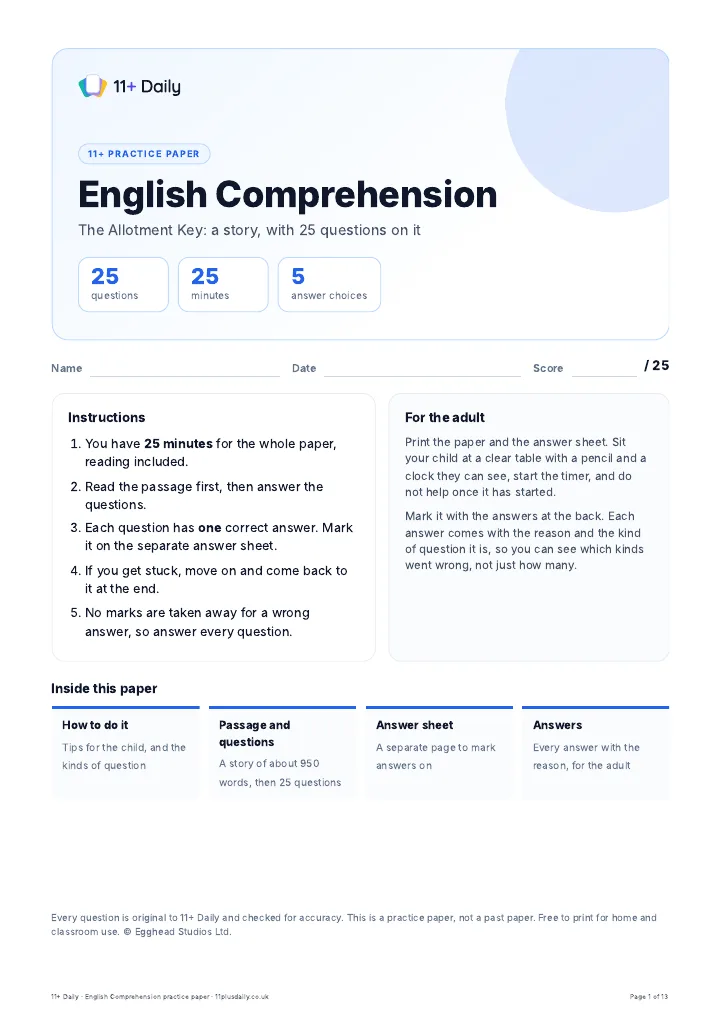
The cover of the 11+ Daily English comprehension practice paper
English

Free 11 plus comprehension practice paper

A passage of about 950 words and 25 questions, to print and sit in 25 minutes. A separate answer sheet, and every answer explained at the back.

  • 25 questions
  • 25 minutes
  • 13 pages
  • Answers explained
  • No sign-up
Get the free PDF

What the 25 questions ask

Finding information

Questions answered by a line in the passage, including one that asks which detail is NOT there.
Inference

What a character feels or means without saying it, and why the writer chose a detail. The largest group, as in most 11 plus papers.

Words and language

Word meanings in context, similes and what they suggest, and one grammar question on a type of word.

The whole passage

What the passage is mainly about, from beginning to end.

Two questions from the paper, worked through

The answers at the back of the paper explain every question the same way.

Question 4

"...behind a gate that shrieked on its hinges." (paragraph 3) What does "shrieked" tell us about the gate?

  1. AIt opened without a sound
  2. BIt was falling off its hinges
  3. CIt made a loud, high noise when it moved
  4. DIt had just been painted
  5. EIt was locked and would not open

Answer: C. A shriek is a loud, high scream, so a gate that shrieks screeches as it swings, which is what old, unoiled hinges do. The word tells you the sound, nothing else.

Why not the others

  • A is the opposite of a shriek.
  • B mentions hinges, but the word describes a noise, not damage.
  • D and E say nothing about sound, and the passage gives no paint and no lock.

Question 5

"The bean canes leaned together at the top like gossiping aunts." (paragraph 3) What is the effect of this comparison?

  1. AIt shows that Priya has a lot of aunts
  2. BIt shows the canes have been blown over by the wind
  3. CIt suggests the canes are old and falling to pieces
  4. DIt makes the canes seem like people chatting
  5. EIt warns that the beans have been badly looked after

Answer: D. It is a simile: the canes are compared to aunts standing close together and gossiping. That turns a frame of sticks into a little group of people, which gives the plot some life.

Why not the others

  • A takes the comparison literally: there are no real aunts.
  • B, C and E read damage or neglect into it, but leaning together is how bean canes are built, and gossiping is friendly, not a warning.

How to use the paper

Print it and set a clock

The paper and its answer sheet. 25 minutes, somewhere quiet, a clock your child can see.

Sit it in one go

No help once the timer starts. A question your child cannot do is worth skipping and coming back to.

Mark it together

The answers at the back explain each one and name the skill, so you can see which skills to practise next.

Daily practice between papers, already planned

Comprehension in 11+ Daily works the same way as this paper: a passage, questions on it, and an explanation that points back to where the answer was. Alongside it, the app chooses a short session of English, Maths and reasoning each day from what your child got wrong, has not tried, or has not done for a while.

Start my free 14-day trial

14 days free, no card. Then £9.99 a month if you carry on.

Questions parents ask

How long is the passage?
About 950 words, in 18 numbered paragraphs, so questions can point to a paragraph. Many 11 plus comprehension passages are a similar length.
Is it a past paper?
No. The passage and every question are original to 11+ Daily. Most areas never publish a past paper.
Is it multiple choice?
Yes, with five options for each question and a separate answer sheet. If your child sits a written comprehension, the same skills carry over: finding the line, reading between the lines and explaining word choices.
How should we mark it?
Use the answers at the back: each one explains why it is right and names the skill. For a wrong answer, go back to the passage together and find the line that held it. That conversation is worth more than the score.

11 plus comprehension: the question types and how to answer them · 11 plus English practice · All the free practice papers